
Confused between which company’s GPU to choose, and don’t want to read cluttered guides? You’re not alone. Many people waste so much of their time and money on wrong decisions. Read this blog to discover the differences between AMD’s vs Nvidia’s GPUs to ensure you never make a wrong decision.
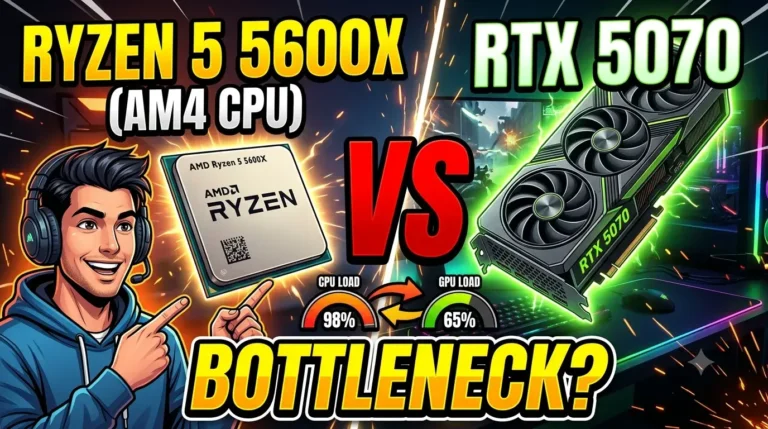
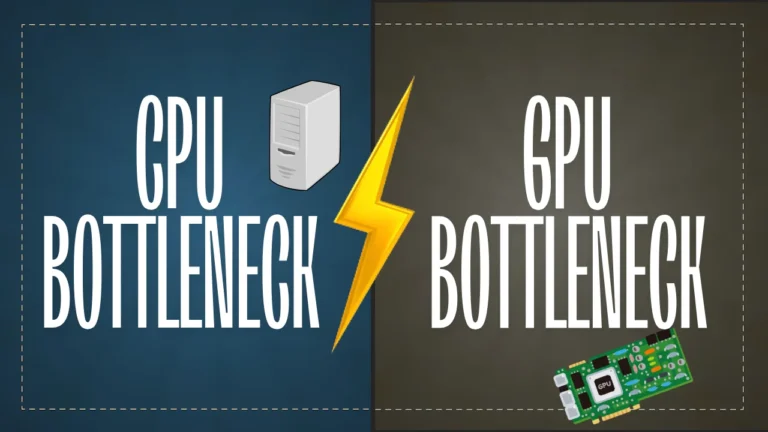
First of all, you need to select a GPU that matches your CPU too. So, your CPU & GPU run smoothly to give you a good performance. For that, you can use the Bottleneck Calculator. Test it out to see which type of GPU will work smoothly with your CPU and other compoents.
AMD vs Nvidia GPUs – Core Comparisons
Key Differences Explained
In terms of architecture for AMD vs Nvidia, AMD uses RDNA architecture for gaming GPUs to give good memory speed. While Nvidia used Ada Lovelace and Hopper architectures, giving stronger ability fo rray tracing, advanced AI tasks, and energy efficiency.
For software, AMD uses FidelityFX Super Resolution (FSR) and Smart Access Memory, while Nvidia uses DLSS, Reflex, and Studio Drivers for creators.
Nvidia drivers are costly and more stable for advanced gamers While, AMD is cheaper and works well with opens systems. Overall, Nvidia is a better option if you prefer gaming. And, AMD is a good value for AI features and ray tracing tasks.
Price and Value: Which Brand Offers More for Your Money?
Nvidia vs AMD’s price’s difference is alot. Nvidia is usually priced at premium rates, most likely die to its advanced features like ray tracing, AI capabilities etc. While AMD is better known for being a valuable option with more VRAM and better cost per frame at a comparatively lower price. Nvidia dominates the higher end (RTX 4090/4080 class) while AMD offers good rasterization power at lower costs.
In laptops, Nvidia laptops are costly and common while AMD’s laptops give better value at a good price. Overall, for making a final decision, you should compare how much performance you get per dollar, in which AMD mostly wins. So, generally AMD is better for budgeted gamers, while Nvidia is better for gamers needing better performance at high prices.
Performance Across Resolutions and Workloads
1080p Gaming: In 1080p gaming, AMD and Nvidia both give almost the same performance, with a moderate price difference. AMD gives better value for this type of gaming at a lower cost.
1440p Gaming: At 1440p gaming, AMD still gives a better value. Both AMD and Nvidia perform equally well. However, Nvidia starts leading in ray tracing, while AMD is still behind.
4k Gaming: At 4K gaming, Nvidia starts to lead with better graphics, ray tracing, and AI features. Tough AMD lacks ray tracing, and AI features, it still provides almost good performance like Nvidia at 4k with rasterization features.
Productivity Workloads: Nvidia perfroams best in 3D rendering, AI features, ray tracing, and video editing. While AMD supports rasterization and open standards.
Overall: AMD is the better option for gaming at somewhat lower resolutions. Therefore, Nvidia may be better for you if you need advanced graphics with ray tracing, and multiple advanced AI features.
Exclusivity and Proprietary Features
Ray Tracing: Nvidia leads in with hardware-accelerated ray tracing features. AMD supports it too but it becomes slow on high-resolution gaming.
Upscaling Technologies: Nvidia uses RX cores and AI for smoother frames and higher resolution output. While AMD FSR works on most GPUs and provides open-standard upscaling with good performance. It does not have AI and advanced ray tracing features.
Driver & Software Suites
Nvidia: GeForce Experience handles driver updates, game optimization, and recording. DLSS boosts performance with AI upscaling, and Studio Drivers support creative apps. Overall, it offers a strong ecosystem for gamers and professionals.
AMD: Adrenalin software provides performance tuning, streaming tools, FidelityFX, and Smart Access Memory. It’s feature-rich and gamer-focused, giving users direct control over settings.
Laptop GPU Showdown
In AMD vs Nvidia’s GPUs for laptops, AMD gives better value in budget at good performance. It sometimes runs slightly hotter under heavy load. While Nvidia gives high-performance value in a high price with advanced features, and mostly better thermal optimization in premium models.
In mid-range laptops, AMD comparatively consumes less battery than Nvidia. But, Nvidia performs better per-watt in top tier models. So, for mid-range laptops, AMD’s GPU is good. While for high-end gaming laptops, Nvidia’s GPU is better valued.
Beyond Gaming: GPUs in Data Centers, Business, and AI
Apart from gaming, GPUs can also be an important factor in other tasks. For heavy-duty AI tasks, video-editing, or etc, go for Nvidia. While, AMD is also a strong alternative with open standards, adaptive commuting and cost-effective accelerators.
Benchmarks and Testing
GPU Benchmarks Hierarchy 2025: Ten Years of Testing
To test different GPUs AMD & Nvidia fairly, they are run on the same system. Each GPU is tested at 1080p, 1040p, and 4K gaming at same settings. So the results can show a clear and fair difference. Over the last decade, Nvidia has lead in high-performance GPUs, while AMD gives somewhat lower performance in high resolution gaming than Nvidia, but in lower price.
Rasterization Benchmarks
Rasterization is the way GPUs render frames in games without ray tracing. At 1080p and 1040p, both Nvidia and AMD deliver almost equally good performance, with better value of money by AMD. In terms of ranking, Nvidia ranks higher than AMD in high-performance GPUs.Overall, AMD is best for pure gaming FPS without ray tracing, while Nvidia leads in high-performance titles
Ray Tracing Benchmarks
In ray tracing, Nvidia generally performs better as it includes advanced AI fratures with ray tracing. It is due to RT cores. AMD also supports ray tracing, but is not as smooth in frame rates (especially at 4K or 1440p). For best performance, balance ray tracing GPU with upscaling techniques (DLSS for Nvidia, FSR for AMD).
Content Creation & Workstation Benchmarks
For creative tasks like content creation, 3D rendering,and CAD & Design, Nvidia works better than AMD. It performs all tasks at a smooth FPS. Nvidia has advanced drivers to work on CAD & Design and uses CUBA & Optics technology for excellent performance in tools like Blender, Maya etc.
Power, Clocks, and Thermal Performance
Nvidia uses more power due to its advanced features, but it stays calm and cool most of the times. Even though on the other hand, AMD also uses less power, but it sometimes get hot.
Test Setup and Hardware for Fair Comparisons
For fair comparison in our reviews, we use the same system, drivers, game/game settings, environment and for the same purpose. It gives off a clear result based purely on each component’s performance.
Nvidia vs AMD: User Experience & Software
Driver Ecosystem and Stability
Nvidia and AMD are both known for frequent updates. Nvidia frequently releases game ready drivers. Nvidia introduces simpler, stable, and heavier drivers. Users sometimes face small craches often on new releases.
AMD on the other hand, also releases regular updates. AMD is getting better at updating, but some users still face minor issues including bugs, UI glitches, and rare black-screens. Although, Nvidia seems to win this point, but AMD gives more built-in functions in their updates compared to Nvidia too. Which somehow justifies the sometimes’s crashes.
Software Enhancements
AMD introduces smart technologies like
- Smart Acess Memory for better CPU-GPU communication
- FidelityFX Super Resolution (FSR) for higher FPS
- Built-in tools for recording, streaming, and performance tuning
Nvidia introduces more stable and simpler updates. It may include
- Auto game optimization, GeForce experience for driver updates, and ShadowPlay recording
- DLSS for AI uscaling and Refpex for reducing input lag
- NVENC encoder used in streaming and video editing.
Strategic & Market Perspectives of Nvidia vs AMD
Nvidia vs AMD: Histories and Market Strategies
Nvidia was founded in 1993, focusing on premium products, advanced features (AI, ray tracing etc), and dominance in gaming. It positions itself as a leader and an innovator, chagring premium prices for their products.
AMD was founded in 1969, focusing on challenging Intel and later on Nvidia. It strategically competes with Nvidia in prices, features, etc to give more value in less price. It tries to be accessible to everyone.
Flagship Products and Key Technologies
Nvidia RTX 4090 is the flagship product. It features 24GB GDDR6X memory and CUDA cores, making it excellent in high performing areas. It has outstanding 4K performance with high power demand (450W).
AMD RX 7900 XTX is the flagship product too. It offers 24GB GDDR6 on RDNA 3 architecture, which makes it highly compatible including rasterization too. It is slightly weaker in ray tracing, but consumes lesser power (335W)
Overall, Nvidia focuses more on cutting-edge and advanced technologies, while AMD tries to offer competitive value at a competitive price.
Pricing Strategy and Market Positioning
Nvidia positions itself as the innovator. Nvidia provides high FPS, ray tracing, and advanced AI features at premium prices. It suits to creators and professionals who are willing to pay a higher price for latest cutting-edge technologies.
AMD positions itself as the value champion. While AMD introduces its products to being more value in a less price. It attracts budget conscious gamers and people who want competitive performance at a lower cost.
Strengths and Weaknesses: Full SWOT Breakdown
Nvidia:
– Strength: Top place in market for best-performance GPUs with advanced technologies (CUDA, DLSS, ray tracing)
– Weakness: Higher power consumption with higher price
– Opportunity: Advancement in AI and data centre growth
– Threats: AMD’s price-performance and Intel’s GPUs, affordable to larger audience
AMD:
– Strength: Competitive pricing with features like strong multi core, rasterization with complete ecosystem (CPU & GPU)
– Weakness: Weaker in ray sharing, AI features, market share, and drive optimization
– Opportunity: Growing demans for cost-effective GPUs, and increased further if AI is expanded
– Threats: Nvidia’s dominance in the market due to AI and CUDA cutting-edge
Recommendations
Best GPUs for Gamers
Budget: AMD gives better performance-per-dollar in entry level GPUs. Nvidia gives advanced and better options too, but at a higher cost.
Mid-Range: In mid-range GPUs, AMD competes well with strong rasterization. While Nvidia’s mid-tier cards have DLSS and ray tracing, perfect for gamers wanting balanced performance.
Flagship:Nvidia’s RTX 4090/4080 gives amazing results in raw performance, 4K, and ray tracing. While AMD’s RX 7900 XTX/XT is perfect for near-flagship gaming experience at a lower price.
Best GPUs for Creators and Workstations
Nvidias takes the lead in GPUs for creators due to its advanced creative performance. It uses CUDA cores latest technologies to give the best value for creators and workstations.
AMD also gives features like ray tracing, etc but it doesn’t give the same performance as Nvidia. It’s budget-friendly for users with less to medium intensity work.
Best GPUs for Business, Cloud, and Data Centers
Nvidia is optimized for advanced AI trainings and had partnerships with Google Cloud. While AMD most probably due to its low price, provides lower performance than Nvidia. It focuses on open world systems more.
So, Nvidia dominates the AI and enterprise adoption due to to its maturity and ecosystem support. While AMD is a challenger with competitive hardware and better value proposition.
The Road Ahead for AMD vs Nvidia & Stocks
Nvidia is expected to maintain and expand their dominance in AI, data centres, and high-end GPUs. Although, if the price continues to rise, its high price may limit its accessibility for everyone and stocks may decrease. For AMD, it’s likely to grow in a competitive environment with value-driven GPUs. But, if they still don’t pay attention to AI, they might start to get outdated as new games release and drop some stocks.
Finally, Nvidia will lead innovation and enterprise markets. While AMD with continue to be good priced and efficient.