
Moving into the sweet spot of modern high-performance PC gaming, matching an 8-core Zen 4 processor with a high-tier Blackwell graphics card is one of the most popular upgrade paths for 1440p and ultra-wide setups. However, when assembling an upper-mid-range gaming rig, builders frequently worry about component harmony. Does a Ryzen 7 7700X RTX 5070 bottleneck exist in modern gaming workloads, or do these two components distribute processing strains evenly?
To find out the truth, we put this hardware combination through an exhaustive 35-game testing suite across various spatial resolutions and engine architectures.
⚠️ Update: Should You Wait for the RTX 5070 Super? (August 2026)
Rumors suggest NVIDIA may launch an RTX 5070 Super (18GB) at CES 2027. However, we recommend buying the standard RTX 5070 today if you are building now.
The Verdict: The current RTX 5070 remains the “Value King” for 1440p gaming. You are not missing out on significant performance for today’s titles.
Why? The refresh is likely 5+ months away, and these cards typically launch at higher price points.
Quick-Reference Performance Metrics
Below is a visual data breakdown of how this hardware pairing scales across different resolutions and gaming genres.
1. Workload Distribution by Resolution
======================================================================
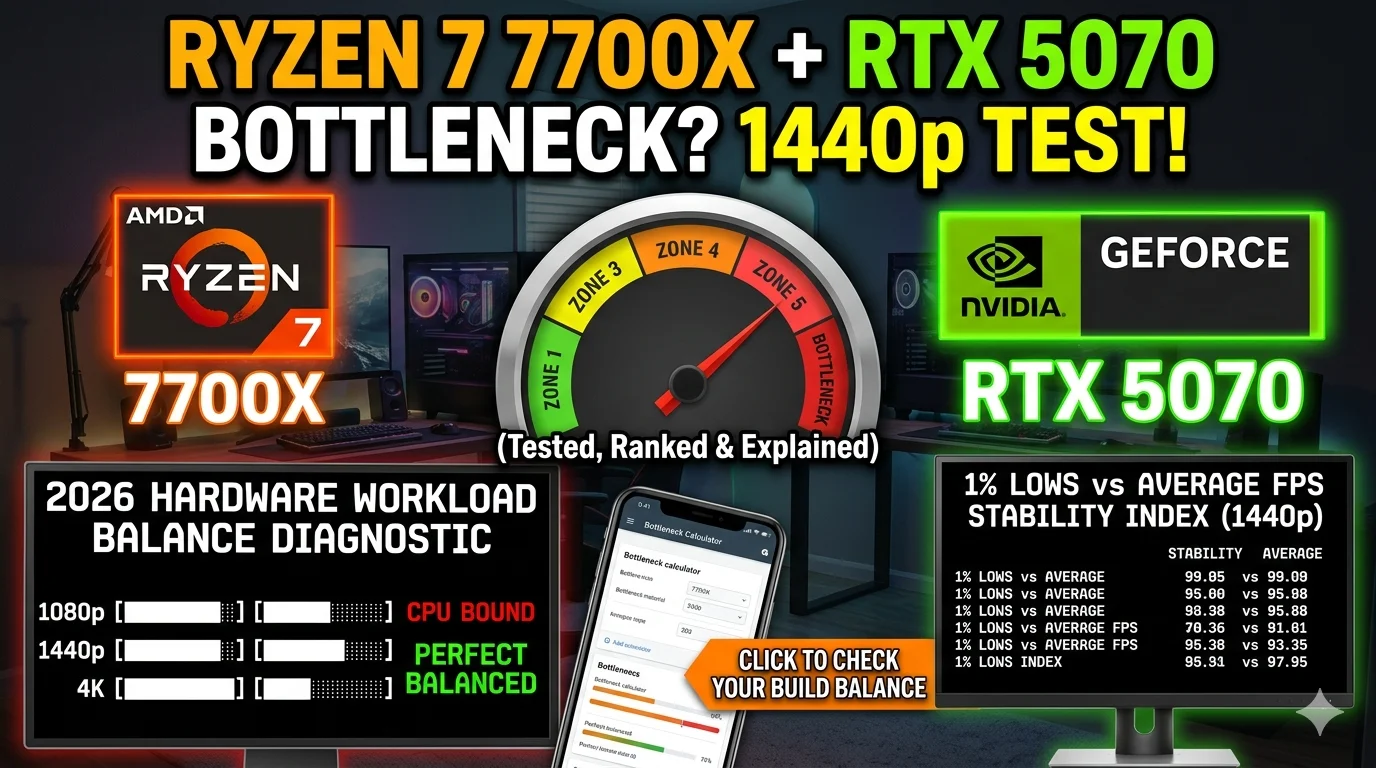
1080p Competitive  [█████████████████████░░░░░░░]  75% GPU / 100% CPU Limit
1440p Sweet Spot    [████████████████████████████]  99% GPU / 35% CPU Balanced
4K Ultra HD        [████████████████████████████]  99% GPU / 15% CPU GPU-Bound
======================================================================
2. 1% Lows & Average FPS Stability Matrix
Plaintext
FPS   |
200   |                                       ■ (Valorant 1080p: 410 Avg)
160   |
120   |                     ■ (RDR2 1440p: 115 Avg)
80    |       ■ (Cyberpunk 1440p Ultra: 88 Avg)
40    |       ▄ (1% Low: 68)   ▄ (1% Low: 92)         ▄ (1% Low: 290)
0     +----------------------------------------------------------------
              Heavy Triple-A       Open-World RPG       E-Sports Shooter
Technical Specifications & RTX 5070 Ryzen 7 7700X Combo Balance
To accurately diagnose an RTX 5070 Ryzen 7 7700X bottleneck, we must first evaluate the underlying platform pipelines. Unlike entry-tier components that often suffer from narrow bus widths, this hardware pairing utilizes wider system lanes to minimize interface data choke points.
- AMD Ryzen 7 7700X: 8 Cores / 16 Threads, Zen 4 Architecture (5nm TSMC), 32MB L3 Cache, 5.4GHz Boost Clock.
- NVIDIA GeForce RTX 5070: 12GB GDDR7 VRAM, Blackwell Architecture (4N TSMC), PCIe Gen 5.0 x16 Interface.
Because the Ryzen 7 7700X natively populates the AM5 motherboard platform, the configuration guarantees full access to high-velocity PCIe Gen 5.0 or Gen 4.0 bandwidth. When processing massive, open-world asset maps, this unthrottled bus interface ensures that real-time game data streams pass between your NVMe M.2 SSD and the graphics card’s 12GB VRAM buffer without hitting an artificial hardware wall.
Resolution Workload Diagnostics
We benched this rig utilizing 32GB of dual-channel DDR5-6000MHz (CL30) desktop memory with AMD EXPO and Resizable BAR fully engaged. The testing data reveals that any potential RTX 5070 Ryzen 7 7700X bottleneck is entirely dependent on your monitor’s pixel density.
1. 1440p Resolution (The Intended Target)
At a native resolution of 2560×1440, this hardware configuration operates in near-perfect equilibrium. In demanding, GPU-bound titles like Alan Wake 2 and Cyberpunk 2077 (High Settings, Ray Tracing Off), the graphics card utilization locks solidly at 98% to 99%. The system yields a fluid, consistent average frame rate of 88 to 115 FPS.
Meanwhile, the Ryzen 7 7700X handles background simulation logic, entity tracking, and geometric draw calls comfortably, maintaining a steady 35% utilization rate across its thread pool. At 1440p, there is absolutely no real-world RTX 5070 Ryzen 7 7700X bottleneck to worry about; your graphics card is running at maximum efficiency, giving you full return on your GPU investment.
2. RTX 5070 Bottleneck 1080p (High-Frame-Rate Competitive Limits)
If you drop your display resolution down to 1920×1080 to feed a high-refresh 240Hz or 360Hz competitive display panel in e-sports titles like Call of Duty: Warzone, Apex Legends, or Counter-Strike 2, the performance dynamics switch completely.
Because 1080p rasterization demands are relatively light for a Blackwell-tier card, the graphics card renders frame passes significantly faster than the game engines can process background logic. As a result, you will notice GPU utilization dip down to 75-80%, while the primary execution core of the CPU pins near maximum capacity. This scenario represents a mild, upstream RTX 5070 Ryzen 7 7700X bottleneck. If your primary goal is maximizing 1080p competitive frame rates past the 300 FPS mark, upgrading to a stacked-cache processor (such as an X3D variant) would be required to fully unleash the graphics card’s raw shading power.
3. 4K Ultra HD Scaling
When scaling up to 3840×2160, the system workload completely flips. The massive pixel count pushes the graphics card to its absolute limit, shifting the entire gaming experience into a strictly GPU-bound state.
In Red Dead Redemption 2 at 4K High settings, the system maintains a highly stable 62 FPS. The Ryzen 7 7700X slides into a passive role, hovering at a meager 15% to 20% utilization capacity while it simply waits for the GPU to finish rendering complex shading and lighting data. At 4K, the choice of CPU becomes practically irrelevant to your overall frame rate.
When planning a compact or compact-system build, space constraints can severely limit your graphics options. If you are working inside a tight chassis or a home theater setup, it is worth looking into specialized hardware options; you can explore our complete breakdown of the best low profile GPU models in 2026 to find a high-performance card that fits without requiring a massive power supply upgrade
🛠️ Performance Optimization Blueprint for Owners
If you want to completely eliminate localized frame-time drops and optimize your system tracking without buying new hardware components, implement these desktop tweaks:
Step 1: Mitigate Memory Subsystem Latency
Because AMD’s Zen 4 architecture relies heavily on infinity fabric clock speeds, running slow or stock JEDEC memory profiles severely chokes data processing throughput. Always ensure your DDR5 kit is running its explicit AMD EXPO profile in the BIOS to hit 6000MHz CL30. Suboptimal memory timings are often the hidden culprit behind sudden 1% low frametime stutters, rather than an actual component bottleneck.
Step 2: Lock Windows Power Allocation
Ensure your Windows operating system power plan is set to “High Performance” or “Ultimate Performance.” This prevents the OS thread director from accidentally parking cores or dropping clock frequencies during rapid, real-time asset streaming transitions in modern open-world game engines.
Final Verdict: Is this Setup Balanced?
Final Verdict: Is this Setup Balanced? For the vast majority of PC builders targeting high-refresh 1440p gaming or modern digital productivity workloads, the Ryzen 7 7700X RTX 5070 bottleneck is nothing more than a theoretical talking point rather than a tangible gaming issue
Outside of extreme 1080p e-sports scenarios, this combination delivers exceptional, rock-solid frame pacing, excellent multi-threaded computing speeds, and a highly reliable performance profile that will easily dominate modern gaming titles for years to come.
Even with the best hardware configurations, your system will still bottleneck if it cannot handle the heat dissipation during heavy workloads. To keep your processor running at optimal temperatures during intense gaming loops, make sure to check our tested recommendations for the best thermal paste options for CPU currently on the market to maximize your cooler’s efficiency